

“Psychic death” is used here as a metaphor for feeling disconnected from your own attention, interests or sense of purpose. It is not a literal death, a clinical diagnosis or evidence that psychic abilities have disappeared. The point of the phrase is to ask a practical question: What would help me participate in my day rather than move through it on automatic?
The original concern is familiar: another notification, another story, another comment to consider, even when you meant to rest. Yet not everyone has the same relationship with technology. A phone can also connect you to friends, accessible services, art and support. The aim is not to condemn screens, but to notice when a particular habit stops serving you.
Recognise a pattern without turning it into an identity
You might open a feed for a message and remain there long after answering it. You may feel pulled to respond to every argument, check reactions repeatedly or carry on browsing when you wanted to sleep. Those are behaviours you can describe and adjust; they do not mean you have no mind of your own.
Start with one concrete example: “I stayed on the app after I felt tired,” rather than “I am spiritually dead.” Notice the setting and your reason for opening it. Were you looking for information, company, distraction or something to do between tasks? A different need may call for a different response.
Do not assume the screen is the sole cause of a flat or disconnected feeling. Workload, illness, grief, sleep disruption and other concerns may also need attention. Replacing a dramatic label with an ordinary description makes room for help rather than shame.
Make one deliberate change to scrolling
Choose a small boundary you can actually use. Before opening a feed, decide what you are there to do. When that task ends, close it and put the phone somewhere convenient but not immediately in your hand. Turn off a nonessential notification if you want fewer prompts; leave necessary contact routes available.
A bedtime change can be especially simple: stop browsing at a chosen point, keep an alarm or essential contact function, and move to your usual wind-down activity. You do not need an elaborate detox plan. The National Institute of Mental Health’s self-care guidance includes making sleep a priority, reducing screen-related blue-light exposure before bed, enjoying low-stress activities and staying connected.
Keep any online tools that genuinely help you. For someone who cannot easily leave home, a video call, an online class or a digital library may be an important form of participation. “Real life” is not limited to offline experiences.
Return to art without making it another performance
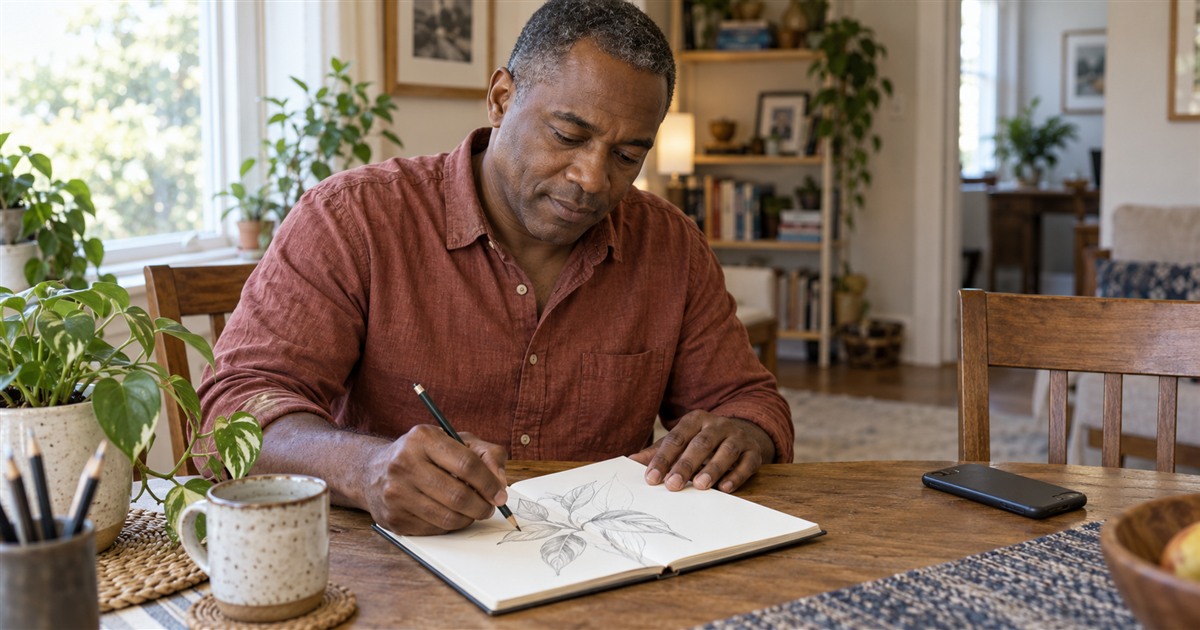
Reading, painting, music, films and art shows were central to the original article, and they remain useful possibilities for personal interest. You can begin much smaller than an outing or a finished project: read a page, listen to one song without browsing, sketch an object nearby or look closely at a painting.
You do not need to be talented, productive or able to explain a profound meaning. Choose what you are curious about, not what will photograph well. You can make something privately and never post it. If sharing is enjoyable, that is also a choice—not a measure of whether the activity counted.
Art may remind you of your own experiences, people or places. A strong memory or emotional response does not establish a past-life connection, and a creative activity is not a guaranteed way to recover a lost purpose. It can simply be one moment worth noticing.
A small screen-to-activity reset
- Finish one online task. Reply to the message or save the information you needed, then close the feed. There is no requirement to answer every opinion.
- Choose one undemanding activity. Read a page, make a few pencil marks or listen to a song. Keep the choice small enough for your current energy.
- Notice, without grading the result. What held your attention? You may feel interested, bored or unchanged. None of those outcomes is a spiritual verdict.
- Decide the next ordinary step. Continue, rest, return to a necessary task or contact someone. You are not obliged to keep going until you feel inspired.
Make room for contact, not compulsory sociability
The wish for human interaction does not require a crowded event or a cheerful public persona. You might send a personal message, arrange a short call, write a note or share an interest with a willing friend. Ask what fits their availability as well as yours.
Being alone can be restorative, and a difficult relationship is not made helpful merely by increasing contact. Choose people and settings where there is room for your needs. If you have limited support, a community activity or qualified service may be worth exploring at your own pace.
For related everyday care without forced positivity, see self-respect from the inside out. You can treat yourself with care even when you do not feel enthusiastic or confident.
Purpose can be smaller than a life-changing revelation
You do not have to solve your whole life before putting the phone down. Purpose for today might mean preparing food, taking care of a necessary task, learning something or making room for a person you value. A job, a hobby and a friendship can matter in different ways; no single activity must justify your existence.
Reflect on what you want more room for, then choose one realistic step. Keep thought and feeling together rather than treating the mind as an enemy of the heart. If spiritual language is meaningful to you, the guide to using vibration language without blame or health promises explains how to connect a metaphor to ordinary choices.
When feeling disconnected needs more than a habit change
A short break may not help when the main difficulty is something else. Persistent loss of interest, hopelessness, changes in sleep or difficulty managing ordinary tasks should not be explained away as spiritual failure. They deserve attention even if you still work, care for others or appear fine to people around you.
The NHS description of depression symptoms includes low mood, reduced interest and effects on daily life. This article cannot diagnose you. Speak with a qualified healthcare or mental-health professional if symptoms persist, worsen or interfere with your life; you do not have to wait for a crisis to ask for support.
If you have thoughts of suicide or cannot keep yourself safe, seek urgent help. In the United States, call or text 988 for crisis support; use local emergency services for immediate life-threatening danger. Outside the United States, use the appropriate local crisis or emergency service.
Frequently asked questions
Does psychic death mean my psychic abilities are gone?
No. In this article it is a metaphor for feeling disconnected or stuck in repetitive habits, not a diagnosis or evidence that an ability has died. It is not a prediction of anyone’s death.
Do I have to quit social media completely?
No. Try a specific limit that fits your life, such as ending one scrolling session or keeping a short bedtime window free of feeds. Preserve useful contact, accessibility tools and urgent communication.
Can art or music cure a persistent low mood?
No cure is promised. Creative activities can be enjoyable or meaningful, but they do not replace professional assessment or treatment. Persistent loss of interest, hopelessness or difficulty managing daily life deserves qualified support.
What if a short break does not make me feel better?
You have not failed. Try a manageable adjustment, ask for support and consider other pressures rather than blaming yourself or assuming a spiritual problem. Seek urgent local help if you are in danger or cannot stay safe.
The concept of resisting ‘psychic death’ is quite compelling. It’s a reminder to nurture our inner lives amid the distractions of modern technology. This could be especially relevant for those who feel disconnected from their own creativity.
The article raises an interesting point about our reliance on social media and the impact it has on our consciousness. It’s important to acknowledge that our attention spans are fragmented and that we often seek validation online rather than engaging deeply with our surroundings.
Indeed, the challenge is in finding a balance between staying connected and maintaining our mental and emotional well-being.
It’s essential to remember that while social media has its downsides, it also offers opportunities for connection and learning. Perhaps the key is mindfulness—being aware of how we utilize these tools and ensuring they serve us rather than control us.
I find the notion of questioning our purpose through the lens of social media somewhat troubling. It’s true that our online interactions often lack depth, but can we truly blame technology for our existential crises, or does the issue run deeper?
Art and creativity are indeed fundamental to our human experience. The idea that engaging in the arts can help us rediscover ourselves and resist becoming numb to life’s experiences is valid and worth exploring.
I agree. Supporting the arts and creative expression can be a powerful antidote to the superficiality that often accompanies our online lives.