

When someone claims to pass on a message from a person who has died, the question “Is this medium real?” can feel deeply personal. You may want comfort, an explanation or reassurance that a relationship still matters. Those feelings deserve respect, but they do not make a claim true.
A polished profile, warm conversation or confident delivery cannot establish paranormal ability. Nor does an awkward session, on its own, prove deliberate fraud. It is more useful to separate three questions: What exactly was claimed? What supports it? How were you treated?
Psychic and medium: what the labels claim
In contemporary spiritual services, a psychic typically claims to obtain information through extrasensory perception. A medium typically claims to communicate with deceased people or spirits. Practitioners may use both labels, and their methods and beliefs vary. These are descriptions of claimed practices, not qualifications that verify an ability.
Ask what the person offers before booking: a spiritual interpretation, an entertainment session, a discussion using symbolic tools, or a claim to convey messages from a deceased person. Clear wording helps you understand what you are paying for. It does not certify that a supernatural explanation is correct.
Keep experience, evidence and conduct separate
Your experience
“I felt comforted.” This describes your response. It need not be dismissed, but it does not identify where the information came from.
The evidence
“The statement was accurate.” Examine the exact words, available information, misses and alternative explanations before drawing a conclusion.
The conduct
“My boundary was respected.” This is observable behavior. Respect matters even though it does not prove paranormal ability.
This separation avoids two common mistakes: assuming that kindness proves a power, or assuming that a single error proves intentional deception. Deliberate fraud concerns dishonesty; an unsupported claim may also reflect sincere belief, guesswork or misinterpretation.
Why a reading can feel unusually personal
Some statements cover a wide range of lives: a difficult period, a family disagreement, someone who was stubborn but caring. You may supply the particular memory that makes a broad statement feel precise. The APA Dictionary’s definition of the Barnum effect describes the tendency to see general or vague descriptions as specifically applicable to oneself.
That possibility is worth considering without turning it into a diagnosis of every practitioner or every client. Notice whether the original statement contained the identifying detail, or whether the detail emerged after you explained what it meant.
For example, “I sense someone connected with your family who had trouble breathing” is not the same claim as a named person, a specific documented event and a detail given before any prompting. Even a strikingly specific statement needs context: public profiles, information shared while booking, prior conversations and chance can affect what seems unexpected.
How to assess a claim without filling in the gaps
If you choose a session, decide beforehand how much personal information you want to share. You do not owe a family history, medical details or private photographs to receive a service. You can ask what information is required and why.
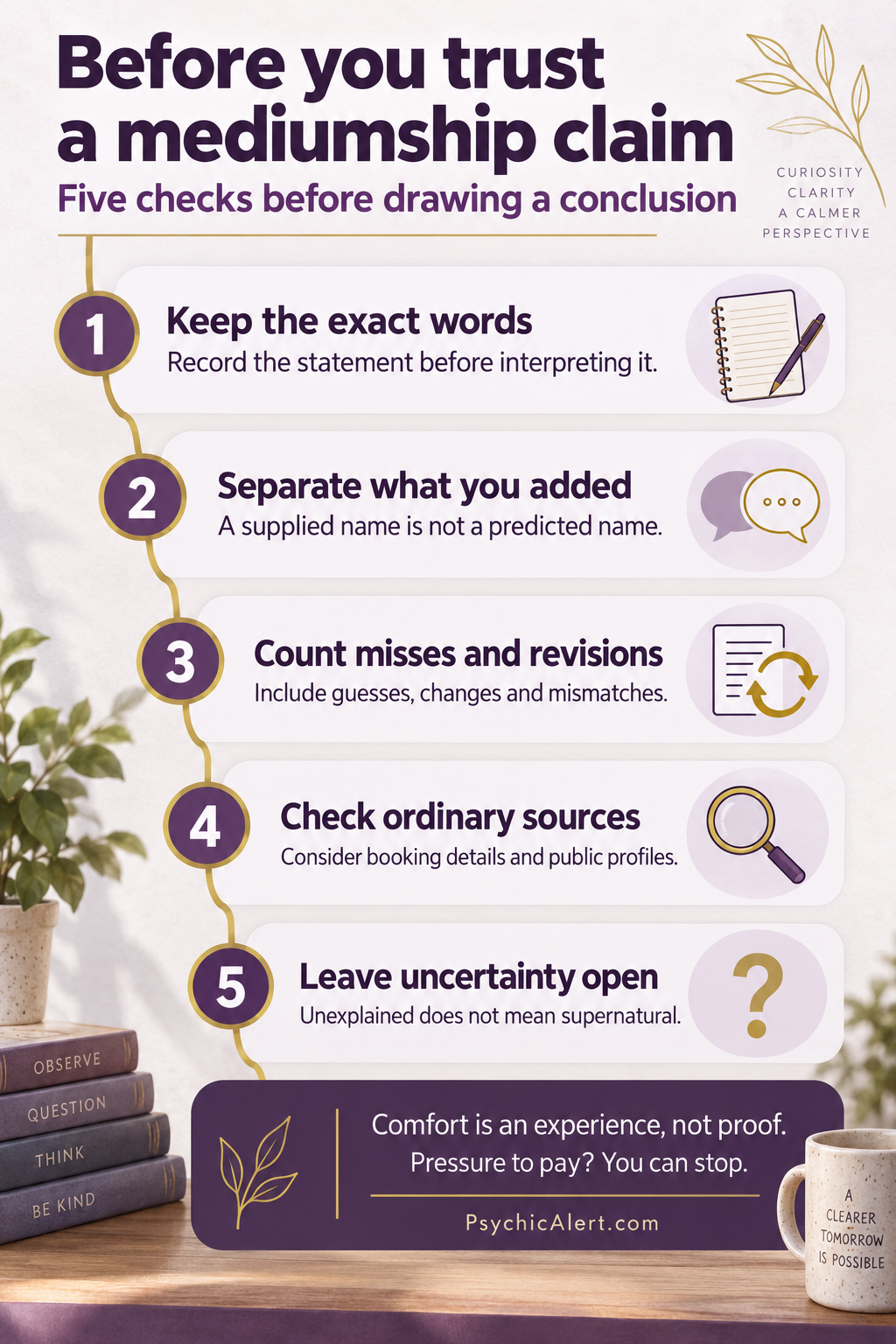
- Keep the original wording. If note-taking is permitted, record the actual statement before interpreting it. Ask permission before making an audio or video recording, and follow applicable rules.
- Separate what was said from what you added. “A name beginning with M” should not later become “They named my mother” if you supplied her name.
- Include misses and revisions. Do not count only the memorable matches. A statement that changes after feedback is different from a clear detail offered at the start.
- Check ordinary information sources. What did you share during booking? What appears on public social media? What was already known from an earlier appointment?
- Leave unresolved details unresolved. “I cannot explain this” is an honest conclusion. It does not require you to accept a supernatural source.
This is a way to think more clearly about a session, not a controlled experiment or a certificate of authenticity. You also do not need to stage a confrontation or persuade the practitioner to agree with your interpretation.
What respectful conduct looks like—and what it does not prove
A clear price, an explanation of the session, permission to decline questions and acceptance when you say “That does not fit” are useful service boundaries. For the practical booking checks, use our eight red flags to watch for with psychics.
Confidence is a presentation style, not evidence. An admission of “I don’t know” can be appropriate. A professional-looking website, years in business, a platform listing or many enthusiastic testimonials also cannot establish contact with spirits. Reviews are more useful for checking concrete issues such as surprise charges or how a cancellation was handled.
As a consumer-protection example, the UK advertising regulator’s guidance for spiritual and psychic services addresses misleading promotion and exploitation of vulnerable consumers. It is UK advertising guidance, not a worldwide licensing scheme or a test of mediumship ability.
Protect your choices when grief is involved
You may find spiritual ideas comforting, and different cultures and faiths approach death differently. A paid reader should not decide how you must remember someone, interpret a family conflict or spend your money. A message attributed to a deceased person is not an obligation to forgive someone, disclose a secret, make a major decision or book again.
Stop if the practitioner claims a loved one is suffering because you have not paid, insists that only they can provide closure, or threatens consequences if you leave. Our guide to fear, urgency and trust in psychic scams explains those pressure patterns.
You can end a session with a simple sentence: “I’m not continuing or authorizing additional charges.” Keep receipts and relevant messages if billing becomes disputed. You do not have to establish whether a power is real before refusing pressure.
A mediumship session is not a substitute for medical care, mental-health support or qualified legal and financial advice. If a reading leaves you distressed, step away and speak with someone you trust. Support from a qualified professional can be an option when grief or anxiety is difficult to manage; seeking it does not require giving up a spiritual belief.
A more useful conclusion than “real or fake”
After a session, ask: Did I receive the service described? Were the charges clear? Were my boundaries respected? What was actually said, and how strong is the evidence for the explanation offered?
You may conclude that a conversation was comforting but its claims remain unverified. You may decide it was not useful, or that its conduct was unacceptable. None of those conclusions requires another purchase. Your memories, decisions and relationships remain yours.
Frequently asked questions
Can positive reviews prove a medium communicates with the dead?
No. Reviews can describe someone’s experience, billing or manner, but they do not independently establish communication with the dead. A comforting session and a verified paranormal claim are different things.
Does a specific detail prove a medium is real?
Not by itself. Consider how precise the original statement was, what information was available beforehand, and how many guesses, misses or revisions occurred. An unexplained detail is not automatically proof of a supernatural source.
Is admitting uncertainty a sign that a medium is fake?
No. Honest uncertainty is preferable to invented certainty. Neither confidence nor hesitation is a reliable test of paranormal ability; evaluate the claim and the person’s conduct separately.
What if a medium says a loved one needs another paid session?
You do not have to buy another session. A claim about a deceased person does not create a financial obligation. Stop if the message uses guilt, threats or urgency, and seek support from someone you trust if it leaves you distressed.
This is really helpful! I didn’t know about the fake reviews part. Thanks for the tips!
*laughs* So we’re supposed to trust a stranger’s vibes about our life? Sounds like a bad episode of a sitcom!
The article gives a lot of good points to consider, like checking reviews and profiles. It’s important to be cautious.
I think psychics can be beneficial if you find the right one! They can help with guidance.
But honestly, who needs a psychic? Can’t we just make our own decisions without some ‘magical insight’?
…I see dead people! Just kidding, but seriously, why would anyone trust these readings?
This is all nonsense. Psychics are just scammers looking to take your money.
‘They want to help you’? Yeah, right! All they care about is your cash!
*sigh* I really hope I can find a psychic that actually helps me… Wish me luck!
… This feels too long, couldn’t they just say ‘be smart and ask questions’? Not rocket science.