

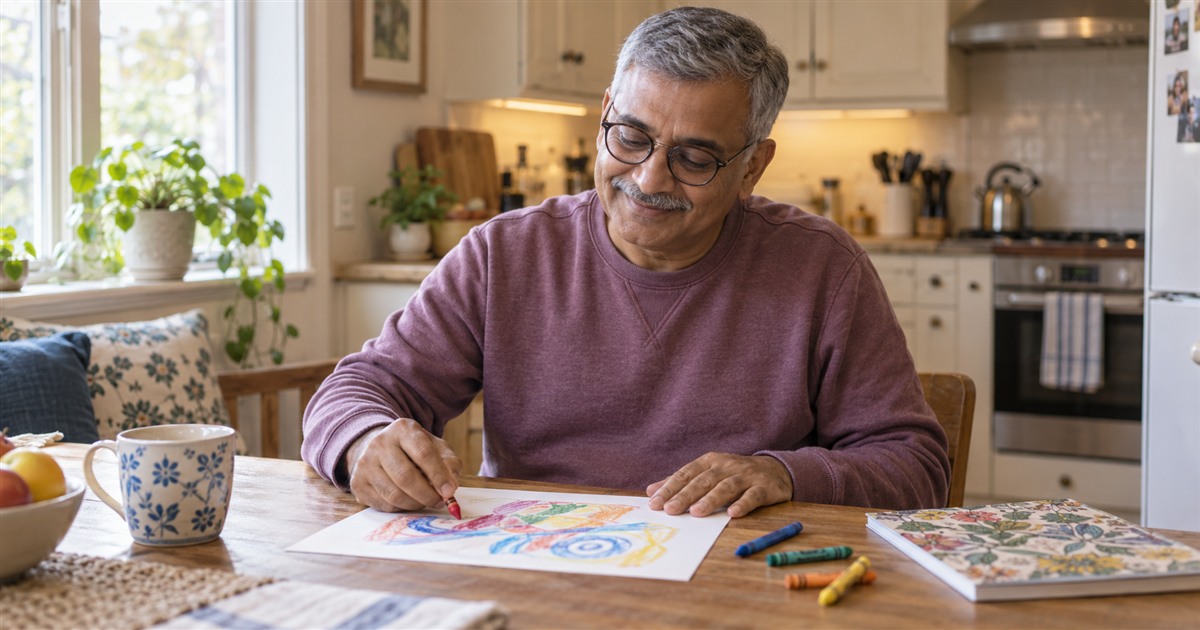
There is room for play in adult life without turning it into another task to master. A box of crayons, a familiar song or a make-believe character can give you something different to notice: what interests you, what you choose and what you would like to try next.
Here, “inner child” is a metaphor for curiosity and imagination. It is not a diagnosis, a separate being or a requirement to revisit childhood memories. The six ideas below are present-day creative activities, not trauma treatment or a method for recovering memories.
Intuition is not certainty. You might use the word for an immediate impression or a preference you have not fully explained. Play can be an occasion to examine that impression; it does not prove psychic powers, spirit contact or knowledge of someone else’s private thoughts. Check important decisions against facts and appropriate advice.
1. Draw without needing a masterpiece
Choose a crayon, pencil or pen and make a few marks on spare paper. You can color a simple shape, sketch an ordinary object or draw something imaginary. Skill, neatness and a finished picture are not the purpose.
Try choosing one color before explaining your choice. Afterwards, ask, “What made this appealing today?” Your answer might be a memory, a mood, a visual preference—or “I don’t know.” Do not turn a color into a diagnosis or a message about the future.
If a blank page feels demanding, use a coloring page or copy a simple shape. If drawing is not enjoyable, choose another activity. You do not need to feel relaxed or receive a special impression for the time to count.
2. Use a puzzle to notice how you approach a problem
A small jigsaw can be enough. You might start with the edges, sort pieces by color or work on one recognizable part of the picture. Notice the approach you choose and whether you want to change it.
For a playful variation, try a different starting point. Does sorting feel satisfying, or would you rather experiment? Finding a piece that fits is a visible result, not evidence that its energy guided you.
Keep the puzzle low-pressure. Looking at the picture, asking for help or putting it away are all reasonable choices. A difficult puzzle does not measure your intuition or your worth.
3. Make room for music in a way that suits you
Choose a familiar song or a short musical experiment. You do not have to perform for anyone, learn an instrument or reach a particular emotional state.
- Play: Try a few comfortable notes on an instrument you already have, or tap a gentle rhythm. Notice which sounds you prefer.
- Move: If comfortable, sway, move your hands or dance in a clear space. Seated movement or simply listening is an equally valid option.
- Sing: Hum or sing a familiar line at a comfortable volume. There is no need to force your voice or control your breathing to create a sensation.
You may give music spiritual meaning within your own beliefs, but that is different from establishing that it changes a psychic vibration or releases invisible negative energy. If you would prefer a quieter activity, our guide to a manageable meditation session offers optional attention practices without a powers test.
4. Notice an ordinary outdoor detail
If convenient, step into a yard, sit on a porch or visit an accessible outdoor space. A view through a window also works. You do not need a hike, an ocean or direct sunlight to participate.
Pick one detail: a leaf’s outline, the changing light or a bird you can observe from a distance. Describe what you actually notice before adding a story about it. “A bird landed nearby” does not establish that it brought a message.
Choose conditions and a location that suit your needs, and respect other people and wildlife. Outdoor time is an option, not a universal remedy or a guaranteed way to become receptive to a spirit realm.
5. Build a small imaginary place without disturbing wildlife
A sand castle or miniature fairy house can be a storytelling project. The imagined inhabitants belong to your story; you do not need to believe that a building will summon fairies, attract blessings or open another dimension.
For a simple home version, make a tiny house from scrap cardboard and paper, or draw its rooms. Decide who lives there and invent one ordinary problem for the character to solve. You can explore several endings without treating one as a prediction.
At a beach or park, check local rules before building or collecting anything. Do not use hermit crabs or other live animals as decorations, strip plants or move habitat materials for a project. The National Park Service’s leave-what-you-find guidance explains why even fallen sticks and leaves have ecological roles and suggests sketches or photographs as alternatives to collecting.
Keeping the project at home with materials you already own is a straightforward way to enjoy make-believe without changing a natural site.
6. Try a character, not a compulsory return to childhood
A scarf, hat or outfit you already own can suggest a character. You might imagine an explorer, a gardener or someone who asks direct questions. There is no need to buy a costume or imitate a culture’s sacred clothing.
Ask, “What would this character try in a harmless everyday situation?” Perhaps an imagined explorer would ask a question instead of assuming an answer. You can borrow that small action without treating the character as a hidden identity or external guide.
If another person joins, agree on the game and let them opt out or change roles. Children do not need to validate an adult’s spiritual ideas, and nobody has to play through discomfort. Your present-day boundaries matter more than committing to a role.
Turn play into a useful observation
After one activity, make a short note if you want. Keep the activity, your experience and your interpretation separate:
- What I tried
- “I drew with three colors for five minutes.”
- What I noticed
- “I enjoyed broad shapes more than fine details. I was still distracted, and that was okay.”
- What I can check or choose next
- “I might try a larger sheet another day. This does not tell me what will happen or what someone else thinks.”
Leave room for an uneventful experience. You do not need to hunt for signs, record every moment or repeat an exercise until you feel something unusual. Our eight optional observation and imagination exercises explain another approach to keeping impressions separate from conclusions.
Choose what is enjoyable and manageable now, rather than what you think you ought to have enjoyed as a child. If an activity creates distress, stop and seek appropriate support if needed. Creative play can remain creative play; it does not have to become a promise of transformation.
Frequently asked questions
What does “inner child” mean in this article?
It is a metaphor for curiosity, imagination and play, not a diagnosis or a claim that you must recover childhood memories. You can try a present-day activity without revisiting your past or using the phrase at all.
Can drawing or play prove that my intuition is psychic?
No. Enjoying an activity or noticing a preference does not establish psychic ability, predict events or reveal another person’s thoughts. Treat an impression as something to consider and check, not as proof.
What if childhood activities do not feel enjoyable?
Choose something different, adapt the activity or skip it. You do not have to reconnect with childhood, complete all six ideas or feel relaxed. Stop if an activity brings up discomfort rather than forcing yourself through it.
How can I try these ideas without buying supplies?
Use scrap paper for drawing, sing a familiar song, notice details from a window or invent a character with clothes you already own. Keep the activity short and optional; expensive tools and paid courses are not required.
This article reminds me of the importance of maintaining a balance between responsibilities and play. It’s essential for a well-rounded and fulfilling life.
While the article is intriguing, I would like to see more scientific evidence supporting the benefits of these activities in enhancing psychic talents.
The article presents an interesting approach to connecting with one’s spirit by embracing activities typically associated with childhood. It is a unique perspective worth considering.
The suggestion to reconnect with nature and engage in creative play as a form of stress relief aligns well with many psychological principles. It’s a practical approach.
Engaging in creative activities like drawing and puzzles to enhance spiritual connection is a compelling idea. It’s a reminder of the often overlooked value of simplicity in our complex lives.
I agree. Simplifying our routines and incorporating play can have profound effects on our mental and spiritual well-being.
Indeed, our modern lifestyles tend to clutter our minds. Embracing playful activities can act as a form of meditation and self-discovery.