

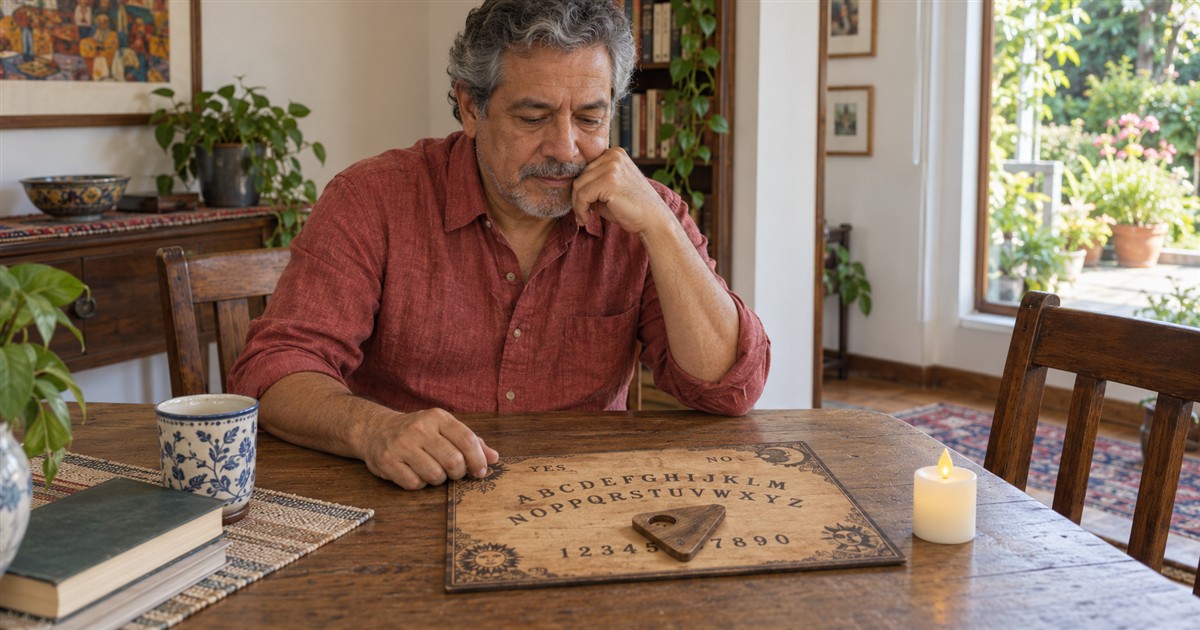
A talking board that spells a name, a candlelit room and a table that seems to move can make a séance feel compelling. But an impressive setting or surprising movement is not, by itself, evidence of contact with the dead. The useful question is not whether a prop looks mystical. It is what happened, what ordinary explanations remain and how much authority you give the result.
These objects can have a place in entertainment, personal reflection or a chosen spiritual practice. They do not provide reliable instructions about health, money, another person’s intentions or your safety. You may be curious without participating, and you may leave without settling every claim.
Ouija boards: movement can feel outside your control
A talking board typically has letters, numbers and simple response words. Participants rest their fingers on a pointer called a planchette, which moves across the surface. A sequence of letters can seem to arrive from somewhere beyond the people at the table.
The ideomotor explanation involves small movements associated with expectations or ideas, without the person necessarily experiencing them as deliberate actions. Feeling that you did not consciously push is therefore not the same as showing that your hands played no part. This does not require accusing another participant of knowingly cheating.
In an eye-tracking study of Ouija sessions, researchers studied 40 volunteers at a paranormal conference. Participants were less able to anticipate letters during ordinary sessions than when deliberately spelling responses. Prediction improved as meaningful responses unfolded, especially when the pair was considered together. The authors proposed that interacting minds could help construct the apparent message.
That exploratory study does not explain every individual experience, and it does not turn a board into a validated test of hidden knowledge. Its findings offer an ordinary explanation for why a response can feel unexpected even when people contribute to it. A spelled name is not sufficient evidence to identify a deceased speaker, accuse a living person or forecast an event.
Candles: meaningful atmosphere is not a mechanism
Candles may symbolize remembrance, prayer or attention in particular traditions and personal practices. Meanings vary; there is no single universal spiritual interpretation of fire. You can use light as a reminder to slow down without claiming it opens a portal or makes a reader more accurate.
A quiet room and an intentional pause may change how a conversation feels. They do not establish where a message came from. Candle color, flame movement or a dramatic mood should not be used to diagnose a curse, decide whether someone is honest or justify another payment.
Fire safety remains ordinary fire safety during a ritual. The U.S. Fire Administration recommends considering battery-operated flameless candles. If using a lit candle, use a stable holder, keep it at least 12 inches from things that can burn and extinguish it before leaving the room or going to bed. It advises against lit candles in bedrooms, bathrooms and sleeping areas. A ritual does not require an open flame.
Table-turning is not the same claim as levitation
Keep different observations separate: a table rotating while hands touch it, tilting onto fewer legs and apparently rising clear of the floor are not interchangeable. A story that simply says “the table moved” leaves important details unknown.
Table-turning was being investigated well before the late nineteenth century. In his letter of June 28, 1853, Michael Faraday described indicators designed to distinguish hand movement from table movement. His observations supported unwitting sideways pressure from participants as the cause in the conditions he examined.
This was not an investigation of every claimed levitation. It shows why the order of movement and the conditions matter. For a modern performance, ask what was visible, what touched the table, whether the view was obstructed and whether an independent check was possible. A camera angle or a confident witness does not settle all those questions. If the mechanism is unknown, “unknown” is a more accurate conclusion than “therefore spirits.”
Three props, three separate questions
- Talking board
- What did the pointer spell, and what could participants have contributed? A response is not an independently verified speaker.
- Candle
- What meaning does the light have for you? Personal symbolism is different from a claim about paranormal accuracy.
- Table
- Did it rotate, tilt or rise? Describe the actual movement and viewing conditions before choosing an explanation.
A tool does not certify the person using it
Cards, crystals, candles and furniture are not credentials. Neither using many props nor refusing all props proves mediumship. Sincerity, warmth and theatrical skill are also different from independently supported claims.
If you are considering a paid appointment, our guide to practical checks before visiting a psychic covers service terms, privacy and the ability to leave. Ask what will happen, what it costs and what topics you may decline. Do not accept an unexpected purchase as necessary to prevent supernatural harm.
You can stop without a closing ritual
Agree on voluntary participation and a clear stopping point before any activity. Do not pressure a reluctant person, use grief to elicit private disclosures or turn a frightening answer into a command. You can put the objects away and return to an ordinary activity.
If you feel unsettled, move to a familiar well-lit space and talk with someone you trust. Fear is not evidence that an entity followed you. Our article on responding to distress without assuming a psychic attack separates feelings from observable behavior and practical support. Persistent fear or disrupted sleep deserves qualified help, not a paid diagnosis from the same activity that frightened you.
Frequently asked questions
Does a moving Ouija planchette prove spirit contact?
No. Movement and a meaningful-looking answer do not establish an external source. Small movements by participants and shared expectations can contribute without anyone feeling that they deliberately produced the response.
Do candles open a portal or improve psychic accuracy?
There is no established basis for treating candlelight as a portal or an accuracy test. A candle may carry personal or religious meaning, but atmosphere and evidence are different things.
Did Faraday explain every claim of table levitation?
No. His 1853 investigation concerned table-turning under the conditions he examined. It supported an ordinary mechanical explanation there; it was not a test of every later levitation claim or performance.
What if a séance leaves me frightened?
Stop the activity, move to a familiar well-lit setting and contact someone you trust. You do not need to buy a cleansing or repeat the session. Seek qualified support if fear persists or disrupts daily life.
The historical background of levitating tables adds a layer of depth to understanding how spiritual tools evolved. It raises questions about the intersection of cultural beliefs and the development of spiritual practices.
The discussion about candles and their role in spiritual practices is intriguing. The emphasis on environment and intention aligns with broader practices in meditation and mindfulness, which could be the key to their effectiveness.
It is interesting to see how different psychics prefer various tools based on their personal methodologies. This diversity in approaches suggests that the effectiveness of these tools may largely depend on the user’s belief and experience.
I appreciate the detailed explanations regarding the ideomotor effect and its influence on the use of Ouija boards. It clarifies some misconceptions about how these devices function and why they are perceived as effective.
The article provides an interesting perspective on various tools used for channeling and connecting with the spiritual world. It’s noteworthy to see the historical context and scientific explanations provided for each tool.