

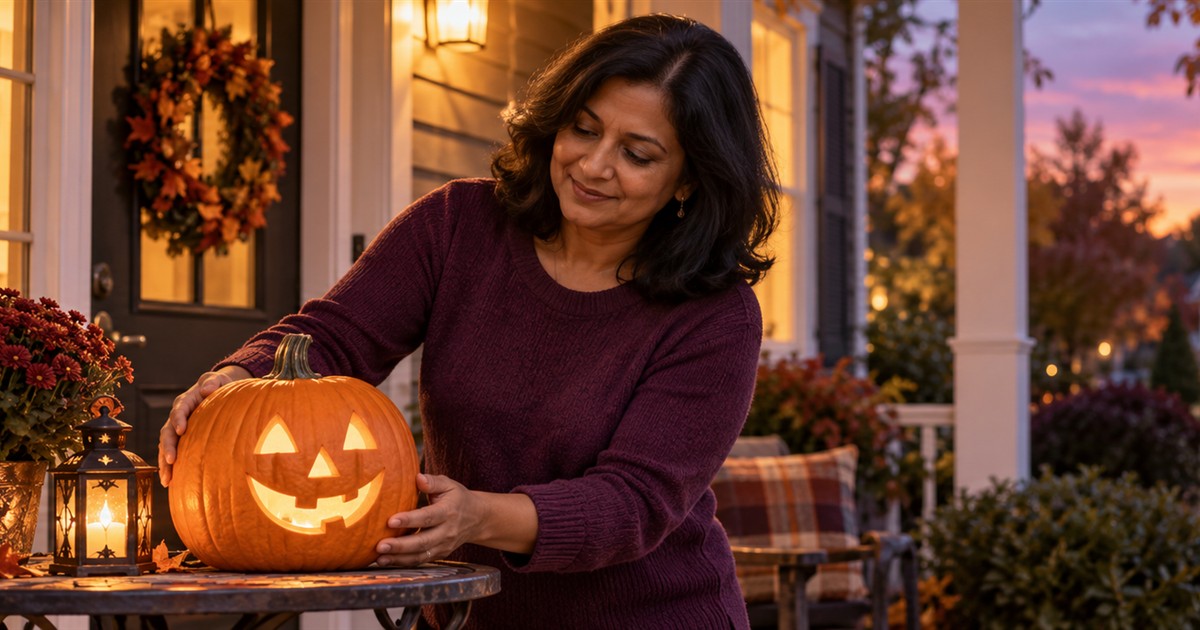
Halloween can feel scary because it brings together dark settings, unfamiliar masks, sudden noises and stories about danger. For some people that is enjoyable make-believe; for others it is uncomfortable, overwhelming or simply not appealing. You do not have to believe in ghosts to dislike a jump scare.
The useful distinction is between a staged fright, a personal belief and a real-world concern. A frightening feeling does not prove that a place is haunted, and October 31 does not make a prediction reliable. You can enjoy the season—or skip it—without buying a reading or testing your courage.
How Halloween builds a spooky atmosphere
Think of an ordinary porch decorated with a mask, a dim light and a sound effect. Each item has an everyday explanation, but together they invite you to imagine a story. Horror films and haunted attractions use similar storytelling choices: they limit what you can see, hold back information and make you wait for the next surprise.
A mask also hides familiar facial cues. A sudden sound can interrupt a calm moment. If you are tired, already worried or reminded of an upsetting experience, the scene may feel different from how it feels to someone else. These are possible reasons for discomfort, not a diagnosis of your reaction.
Stories and traditions are not proof of supernatural danger
Halloween is not one uniform religious practice. People participate for different reasons, including costumes, neighborhood gatherings, seasonal decorations, storytelling or their own spiritual observances. Others choose not to celebrate.
The U.S. State Department’s overview of American Halloween customs describes a mix of traditions and familiar symbols such as masks, ghost stories and jack-o’-lanterns. A symbol’s place in folklore does not establish that the event described in the story occurs in real life.
Respecting someone’s beliefs does not require treating every supernatural claim as fact. Equally, disliking frightening entertainment does not require mocking the beliefs of people who observe the season differently.
Choose the version of the season that suits you
Keep it gentle
Choose autumn decorations, a friendly costume or a quiet gathering instead of horror scenes.
Check the details
Ask about jump scares, flashing lights, loud sounds and whether you can leave an activity easily.
Keep your choice
You may decline, change plans or leave. Participation is optional, not a test of bravery.
For a gathering at home, tell guests what to expect. Do not surprise someone with a frightening prank after they have asked you not to. Leave room for different comfort levels rather than assuming everyone enjoys being startled.
If you are choosing activities with children, ask what feels fun and what feels too much. A familiar adult can explain that a costume is pretend without dismissing the child’s feelings. Avoid pressuring a frightened child into an attraction just to prove it is not real.
When fear needs support rather than another spooky explanation
Not enjoying Halloween is not itself a phobia. The National Institute of Mental Health distinguishes occasional fear from anxiety disorders that persist and interfere with daily life. A professional assessment—not a holiday checklist—is needed to understand ongoing difficulties.
Consider qualified support if fear repeatedly disrupts sleep, work, school or ordinary activities, or if you are struggling to cope. Do not assume unfamiliar physical symptoms are “just anxiety” or a spirit’s presence; get appropriate medical advice. For an immediate safety or medical emergency, use local emergency services.
If nighttime worry is part of the problem, our guide to nighttime intuition, sleep and anxiety separates experiences from conclusions and offers a morning review method. It is not a substitute for care.
Halloween offers: do not confuse urgency with evidence
A reader may advertise seasonal availability or a Halloween-themed session. That does not establish that messages are clearer, a barrier between worlds has changed or a reading is more accurate on that date. Such claims belong to belief or marketing, not a verified reason you must purchase.
The more concerning situation is an offer tied to fear: “Only tonight can I remove this curse,” “Your family is at risk,” or “You must pay again to finish the protection.” A frightening story is not proof that a danger exists. You are allowed to stop the conversation and seek an independent perspective.
Before paying, check the total price, cancellation terms and what the session actually includes. Do not share security codes or account-login information. Our guide to fear, urgency and repeat fees explains how pressure can turn an optional service into repeated purchases. If you believe you were deceived, preserve messages and receipts and ask the platform or payment provider what complaint options apply.
A calmer way to think about Halloween
Ask three separate questions: “What is the decoration or story?”, “How am I feeling?” and “What can I independently check?” Keeping those questions apart helps avoid turning a strong feeling into a claim about hidden danger.
You can admire a pumpkin, enjoy a ghost story as fiction or choose a completely different evening. The season does not require you to accept a supernatural explanation, spend money to feel safe or prove that you are unafraid.
Frequently asked questions
Does Halloween make ghosts or psychic messages more real?
A date, decoration or frightening feeling does not establish that a ghost is present or that a psychic message is accurate. Claims about stronger Halloween readings are spiritual or promotional claims, not a guarantee.
Why can I feel scared even when I know a Halloween scene is pretend?
Darkness, unexpected sounds, masks and suspense can still feel unsettling when you know they are staged. The feeling alone does not show that anything supernatural is happening. You can choose a gentler activity or leave.
Do I have to visit a haunted attraction to get over my fear?
No. You can decline optional entertainment. If fear is persistent or affects everyday life, seek qualified support rather than forcing yourself through an attraction or treating it as a self-directed therapy exercise.
What should I do if a Halloween reading says I must pay to remove a curse?
Do not treat the claim as evidence that a curse exists or that payment is necessary. Pause, refuse further purchases and keep relevant messages and receipts. If you suspect deception, contact the platform or payment provider about complaint options.
So let me get this straight: we have one day to dress up as scary stuff & it’s all okay, but talking to a psychic on that day is frowned upon?? 😂 Sounds like a double standard to me!
.Umm… does anyone else find it ironic that we fear witches but love dressing as them? 🙃 Maybe we should rethink how we celebrate instead of blaming psychics!
I totally agree with the article! Halloween is so fun, and it should be about having a great time with friends and family. Who cares if some people believe in ghosts? 🎃 Let’s celebrate!
!Hallowen is best time ever! 🍬🕷️ I love candy and costumes but this stuff about psychics makes no sense!! Who wants to talk to ghosts anyway?! Let’s just have fun and eat candy!!
This article highlights a crucial issue in society. The psychic industry indeed preys on vulnerable individuals, particularly during emotional times like Halloween. Awareness can prevent exploitation of sensitive people.
‘Psychics are fraudulent’ says the article yet here we are still believing in fairy tales! Why not expose more than just one side of this debate? It’s simply too biased for my taste.
This post is so misleading. It makes it seem like all psychics are frauds! What about the ones who actually help people? This black-and-white thinking is harmful, not everyone exploits others! 😒
You’re missing the point. Even if a few help, the majority are just after money! People need to be careful and not fall for these scams, especially during Halloween!
But aren’t most psychics just con artists? I mean, how can you trust someone who claims to talk to the dead? It’s just ridiculous to me! 🤷♀️
The discussion around Halloween is necessary but let’s not forget it’s also a time for joy and community spirit! It doesn’t have to be all gloom and doom; we can enjoy without exploiting others!